Answer Engine Optimization (AEO): The New Cornerstone of Visibility in the Age of AI
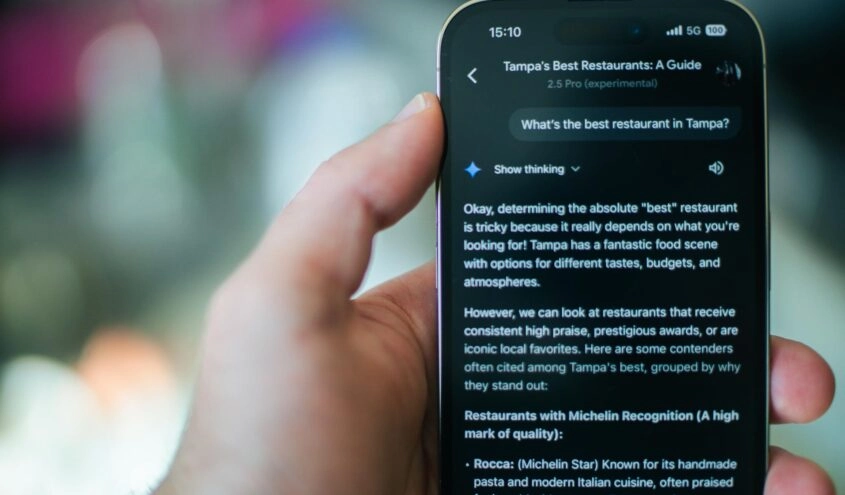
The world of organic search is undergoing an unprecedented transformation. In the past, the goal was to appear in a list of blue links (the famous SERP). Today, with the emergence of AI-powered conversational search engines, users are no longer just looking for websites—they expect immediate answers.
This is where AEO (Answer Engine Optimization) comes in. As an essential component of GEO (Generative Engine Optimization), it redefines how brands must design their content marketing strategies to remain visible in this new information-search ecosystem.
Answer Engine Optimization (AEO) refers to the set of techniques designed to optimize content so that it can be understood, summarized, and delivered directly by answer engines. Unlike traditional SEO, which focuses on ranking in search engine results pages (SERPs), AEO aims to transform your expertise into the single answer provided by AI.
Conversational engines now analyze the deeper meaning of content, factual accuracy, and the reliability of sources. They no longer simply match keywords; instead, they select the most structured pieces of information to generate a voice or text summary. In the era of GEO (Generative Engine Optimization), being cited by these engines is becoming a new driver of visibility that should not be overlooked.
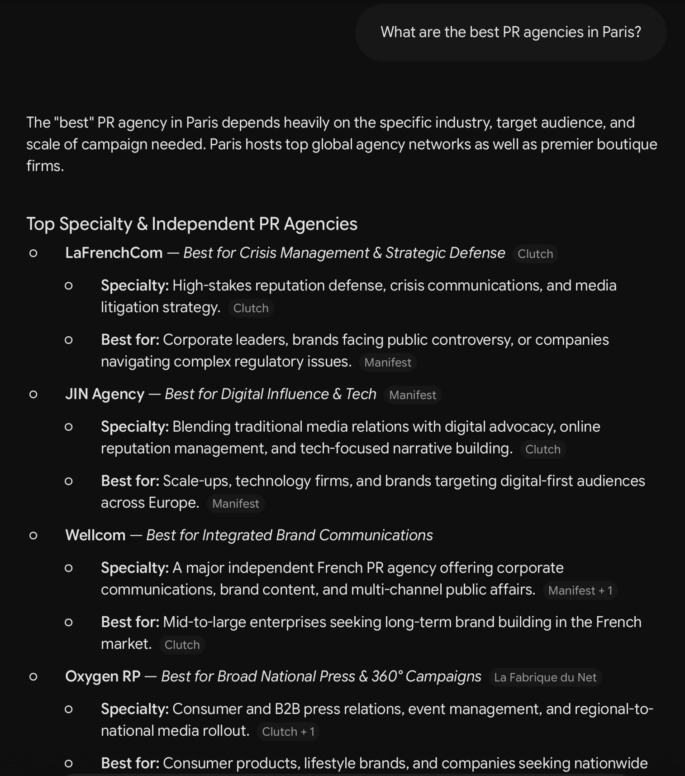
A concrete example: In response to the question “What are the best PR agencies in Paris?”, the AI will generate a structured paragraph detailing a specific number of agencies, drawing on sources considered highly authoritative, such as recognized media outlets, rankings and comparison platforms, corporate websites, business listings (such as those on Google), and encyclopedic sources like Wikipedia.
Although complementary, these three approaches serve distinct objectives within your visibility funnel.
The traditional foundation. It aims to rank your website on Google and other search engines through keywords, backlinks, and a solid technical architecture. It’s a long-term effort to drive organic traffic to your pages.
GEO is the comprehensive strategy that encompasses all methods for achieving visibility on AI-powered search engines.
AEO is one of GEO’s operational levers. It involves optimizing content for AI conversational engines so that it can be incorporated into a response (focusing on format and content optimization). It requires meticulously structured information so that it can be instantly “processed” by LLMs.
All these concepts are interconnected; AEO is an integral part of GEO, and SEO also influences GEO.
Adopting an AEO strategy offers immediate benefits that go beyond the simple click:
To meet the new expectations of “response drivers,” here are the strategic approaches to adopt:
Delve into your users’ psychology. If a user asks, “How do I raise funds?” they aren’t looking for a definition—they want a step-by-step guide. Your content should be straightforward, without any unnecessary preamble.
AI needs clear reference points. To facilitate semantic indexing:
In spoken language, requests tend to be longer and more natural. Replace your overly short headlines with direct questions. Imagine how your customer would phrase their request out loud, and incorporate those phrasings into your headlines.
AI prioritizes sources it deems credible. To do this:
AEO does not replace SEO; it complements it. In a world where E-E-A-T (Experience, Expertise, Authority, Trust) has become the guiding principle for algorithms, AEO allows technical visibility and editorial relevance to coexist.
While SEO makes you visible in a list, AEO makes you indispensable in the answer. Don’t let artificial intelligence overlook your expertise—start preparing today for the trends of tomorrow.
Need to optimize your content for the new search engines?