ChatGPT Ads in France: The Complete Guide for Advertisers

For years, looking up information meant one thing: opening Google and typing a few words into a search bar. Today, usage patterns are changing. On Google, results now include AI-generated answers, notably through AI Overviews, powered by Gemini. At the same time, more and more internet users are turning to conversational tools like ChatGPT to ask their questions directly.
And since late August, this conversation can also become an advertising space: OpenAI has launched self-service ChatGPT Ads in 31 European markets, including France.
Until now, running an ad on ChatGPT required going through OpenAI’s sales teams or one of six handpicked media groups: Publicis, WPP, Omnicom, Havas, dentsu, or MediaPlus. That is no longer the case. A French SME or startup can now create an account, add a payment method, and launch its first campaign without an intermediary.
So, how does this new advertising tool work, and what opportunities does it open up for brands? Oxygen breaks down what you need to know about ChatGPT Ads.
On Google, a user types in short search queries, such as: “CRM software for small businesses.”
In ChatGPT, the user’s request is more detailed and sounds more like: “I’m looking for a CRM for a small business with 30 employees that’s easy to use, integrates with Gmail, and is suited for a small sales team.”
The difference is significant. ChatGPT has a much richer context regarding the expressed need: company size, constraints, tools already in use, and specific expectations. This is the logic upon which the entire ChatGPT Ads system is based.
Ads may appear alongside ChatGPT’s responses when they are deemed relevant to the conversation. They are clearly identified as sponsored, distinct from the AI-generated response. A brand therefore does not pay to be mentioned in a response; it purchases an ad slot within the experience.
Who can see these ads? Only users of the free plans. Plus, Pro, and Business accounts do not see them, nor do accounts identified as belonging to minors.
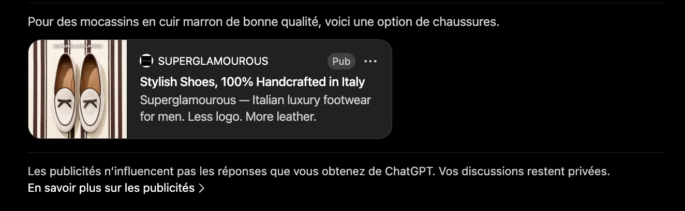
Please note: Brands that appear in the initial preview or in product recommendations have not necessarily paid to be included. Sponsored content, on the other hand, is clearly identified as such and appears in a dedicated section at the bottom of the search results.
This is what most distinguishes this channel from traditional search: there are no keywords to buy. ChatGPT Ads targeting is based on contextual cues and descriptions of the type of conversation being targeted.
For a public relations agency, the challenge would therefore not be to target “PR agency,” but to focus on search intentions such as:
We’re shifting from a keyword-based approach to a needs-based approach. This is precisely what sets it apart from traditional advertising networks.
The structure of a campaign:
Sign-up takes place at ads.openai.com, where you’ll need to verify your business and add a payment method. The ChatGPT Ads account is then organized into three levels, similar to most ad networks:
Two objectives are available at launch: reach, billed on a CPM (cost per thousand) basis, and clicks, billed on a CPC (cost per click) basis. There is no minimum budget requirement, which makes it easier to run initial tests.
ChatGPT Ads does not replace Google Ads; the two come into play at different stages of the customer journey.
Google remains highly effective when the user already knows what they’re looking for and enters a specific query. ChatGPT comes into play more often when the search requires some thought or comparison, for example: “What kind of agency should I choose to support the launch of a B2B brand in France?” The conversation then allows the user to gradually refine their needs.
The user is at a different stage of the buying journey.
The question, therefore, is not about choosing between the two, but about determining which tool is most relevant depending on the stage of the user’s journey.
Like Google Ads or Meta Ads, ChatGPT Ads operates on an auction basis. For CPC campaigns, OpenAI currently recommends starting at around $3 to $5 per click—a suggested bid level for testing the platform, not a guaranteed rate for each click.
Startups and small and medium-sized businesses with smaller budgets can now experiment without having to commit the amounts previously reserved for large accounts.
Conversion tracking is handled via a pixel and a Conversions API, using a model similar to what already exists on Meta or Google. OpenAI also offers a dedicated app within ChatGPT—ChatGPT Ads Manager—to create ads, manage the account, and view metrics directly in conversational mode.
One limitation to be aware of: there is currently no native CRM connector, which leaves attribution imprecise. At this stage, it’s difficult to accurately link a ChatGPT conversion to an actual sale in your CRM.
Another point for European advertisers: the platform is launching without advanced personalization. Targeting relies solely on the current conversation and limited contextual information, without drawing on past conversation history or user preferences.
The arrival of advertising in ChatGPT has given rise to a new term: GEA, short for Generative Engine Advertising.
The concept is similar to the SEO/SEA pairing: a company can build its authority to appear organically in ChatGPT’s responses, while using advertising to support specific offers or strategic objectives. These are two distinct levers, but they are becoming increasingly complementary.
The biggest pitfall would be to approach ChatGPT Ads exactly the same way as Google Ads. Before launching a campaign, it’s best to start with the questions customers are actually asking themselves:
These intentions then serve as the foundation for building campaigns, ads, and—most importantly—landing pages. If a user articulates a very specific need in ChatGPT, sending them to a generic landing page makes no sense: the more precise the conversation, the more precise the ad response must be as well.
Practical steps for setting up a test on ChatGPT Ads:
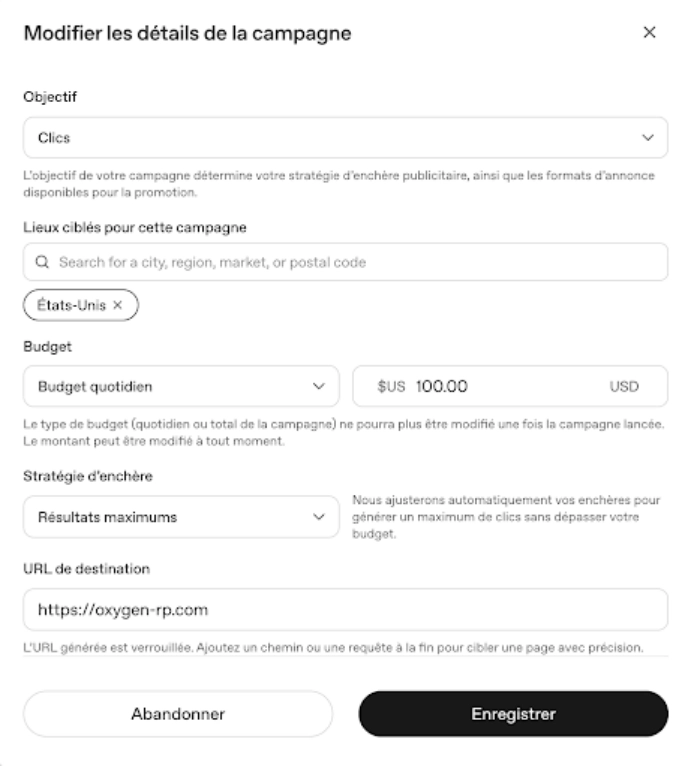
Shifting from a keyword-based approach to an intent-based approach requires some serious groundwork: identifying the questions your customers are actually asking, rephrasing them as relevant contextual cues, and aligning your landing pages with the specific context of the conversation that led the user to you.
Oxygen, a communications and media relations agency, helps you create your ChatGPT Ads—from defining the intents to target to setting up your first campaigns—by carefully analyzing the questions and contexts in which your brand should appear.